

A split second, and then a decade
Matteo Thun makes a claim about how design is judged that should worry anyone who specifies for a living. Walk into a hotel room, he says, and you know within a split second whether you like it. The verdict is instant, instinctive, almost involuntary.
He has then spent forty years designing for everything that happens after that second.
That gap — between the instant we judge a space and the decade we spend inside it — is the most useful idea in contemporary interior design, and it belongs to an architect most Australian specifiers know by reputation rather than by argument. Thun co-founded the Memphis Group with Ettore Sottsass, art-directed Swatch, taught design in Vienna for seventeen years, and has won the Compasso d’Oro three times. His studio in Milan works across hospitality, healthcare and residential. He is not a marginal voice.
He is also unusually blunt about the industry that pays him.
The phrase, and where it actually comes from
Thun frames his interiors around an aphorism: “Touch with the Eyes. See with the Hands.” He used it most recently to describe stepping from open water into a saloon — surfaces read tactile before you reach them, and confirm themselves when you do.
What’s less known is that he doesn’t claim it. Asked about designing furniture, Thun credits the underlying idea to Goethe — the observation that the eye touches and the fingers see. It is not a design slogan. It’s a two-hundred-year-old account of how human perception actually works, which Thun has simply refused to let go of while the rest of the industry designs for the camera.
Worth sitting with, because the implication is uncomfortable. If the eye touches, then a photograph can satisfy the eye completely — and tell you nothing whatsoever about what the hand will find.
“Touch with the Eyes. See with the Hands.”
Two kinds of durability
Ask Thun how durability gets built into a project and he splits it in two.
The first is aesthetic. He avoids movements and -isms, on the grounds that anything fashionable is by definition temporary. His verdict on his own industry is withering: most furniture has a life cycle of under five years, and the majority of what appears at the Milan fair each year never even reaches production. Companies that operate that way, he suggests, have no real confidence in their own judgement.
The second follows from the first, and he calls it affordability. A product that stays desirable for fifteen or twenty years costs its owner a fraction of one replaced four times. His formulation of the link is three words long: durability is sustainability.
Then he says the thing that makes this worth reading.
He wants longer life cycles for everything he designs even though it means less business for the suppliers who furnish his projects. An architect openly arguing that the industry serving him should sell less, more slowly, because that is what serves the building.
We sell surfaces. We think he’s right.
The chairs he can’t destroy
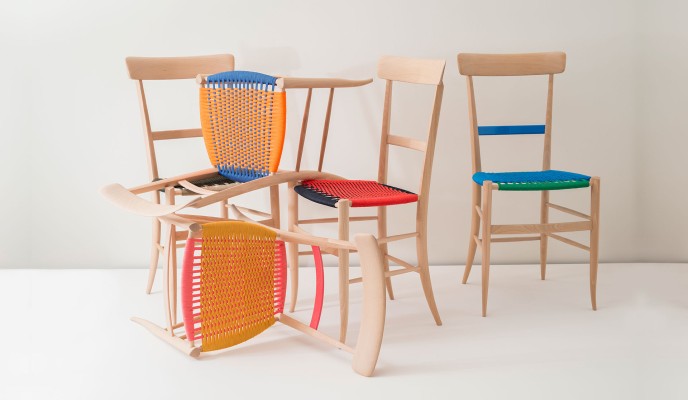
Thun’s own example of durability isn’t a designer piece. It’s the Chiavari chairs in his house — old, light, belonging to no identifiable style, by a designer nobody can name. He reckons they’ll last a century, and notes that even his sons haven’t managed to wreck them.
That’s the whole argument in one image. Not precious. Not fashionable. Simply built well enough that a decade of ordinary human use leaves no mark worth mentioning.
It’s also, precisely, a specification standard. Can this survive being lived with?
The triangle every designer knows
Thun describes the commercial reality plainly. The architect sits between an investor with a fixed number and an operator who needs more than that number to hit revenue. The designer stands in the middle protecting the vision through continuous cost engineering, walking a narrow line to keep quality alive — and if they fall off it, the project dies.
Every commercial designer in Australia knows that triangle intimately.
Which raises the question the triangle always eventually asks: when the value engineering starts, what do you protect?
Thun’s answer is consistent across four decades of work. Protect the things that determine whether the space is still good in ten years. Let the temporary things be temporary.
Where this lands on a wall
Walls are where this argument is easiest to lose, because a wall finish is chosen from an image, approved from an image, and then touched every day for a decade by people who never saw the image.
A residential wallpaper and a commercial wallcovering photograph identically. They are not the same object. One carries its colour and its texture through the body of the material; the other carries a print on the surface. One is built to be cleaned; the other is built to be looked at. Both are entirely fit for purpose — the purposes are simply not the same.
Thun’s aesthetic durability is the design still working in year ten. His affordability is the wall specified once instead of four times. Neither is visible on a sample board.
The eye touches. The hand sees. Specify for both.
Sources
Matteo Thun on Zero Design, aesthetic durability, affordability, Goethe, the Chiavari chairs and the investor–operator triangle — interviewed by Kim Megson, CLADmag 2018 issue 2: https://www.cladglobal.com/architecture-design-features?codeid=32841
“Touch with the Eyes. See with the Hands.” — as used for the Azimut Seadeck 9 interiors by Matteo Thun & Antonio Rodriguez, THE ONE Yacht & Design: https://theoneyd.com/seadeck-9-the-time-we-choose-to-live/
Matteo Thun & Partners, on Zero Design: https://www.matteothun.com/category/2/design/
Hume Internationale supplies commercial wallcoverings, residential wallpapers and bespoke digital print across Australia and New Zealand. Matteo Thun is not associated with Hume Internationale; we quote him because he’s right.