
The Brief · Design history · The painted wall
The wallpaper China never hung.
Europe’s most coveted wall arrived from Canton by ship, in numbered sheets, painted by hand — for a market that didn’t exist at home.
At Woburn Abbey a few years ago, a historic interiors specialist working through the archives found an invoice dated 1752. It recorded the purchase of “India” paper for the fourth Duke’s private bedchamber, and a decorating firm — trading, gloriously, as Crompton and Spinnage — engaged to hang it.
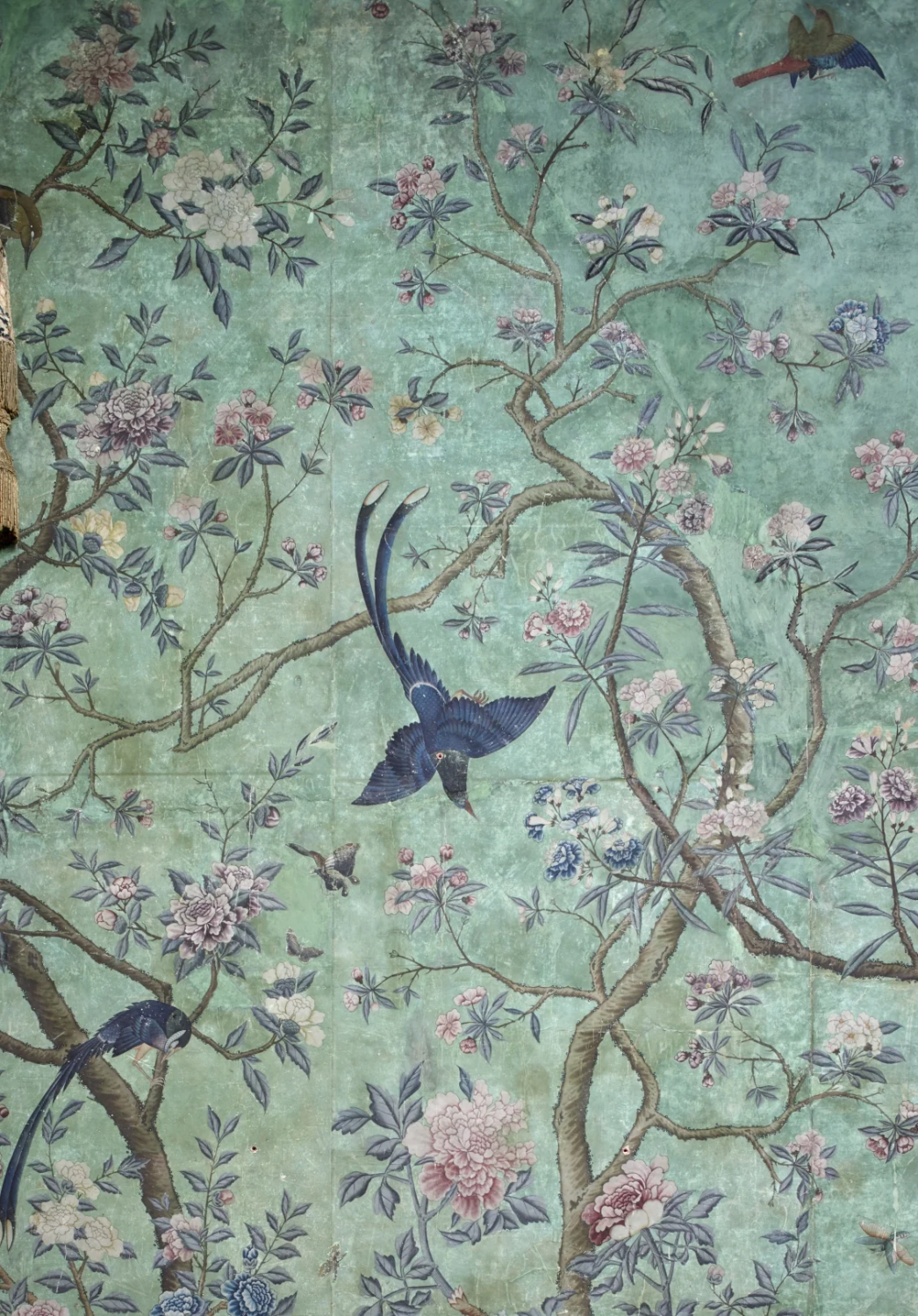
The team began stripping back the layers that had accumulated over two and a half centuries. In June they found fragments. In December they found the wall: a silver pheasant among pink tree peonies, a small bird in the lower corner, hand-painted in Canton and waiting behind the wallpaper of five later generations.
Named for the ship, not the place
It was never Indian. “India paper” was shorthand for anything the East India Company brought back from Asia, and the name stuck to the cargo rather than the country. The papers came from Canton, carried as private trade by the captains themselves — a sideline in the hold of a company ship, sold at auction in London.
The scale of that sideline is easy to underestimate. A single company vessel in 1776 carried 2,236 pieces of paper: enough to cover the walls of roughly a hundred rooms.
By the middle of the eighteenth century, most great houses in Britain had a Chinese drawing room or a Chinese bedroom, and by the century’s end the fashion had reached far more modest homes. What made these papers irresistible wasn’t only the painting. It was that they showed things nobody had seen — birds, insects and plants unfamiliar in Europe, people in unfamiliar dress, buildings and landscapes that existed only in report. The appeal lay in the depiction of difference, executed with obvious technical mastery.
Chinese porcelain of the same period was frequently adapted to European taste, decorated with Western motifs for Western buyers. The wallpaper wasn’t. It stayed itself.
The part that still surprises people
The Chinese did not hang these papers.
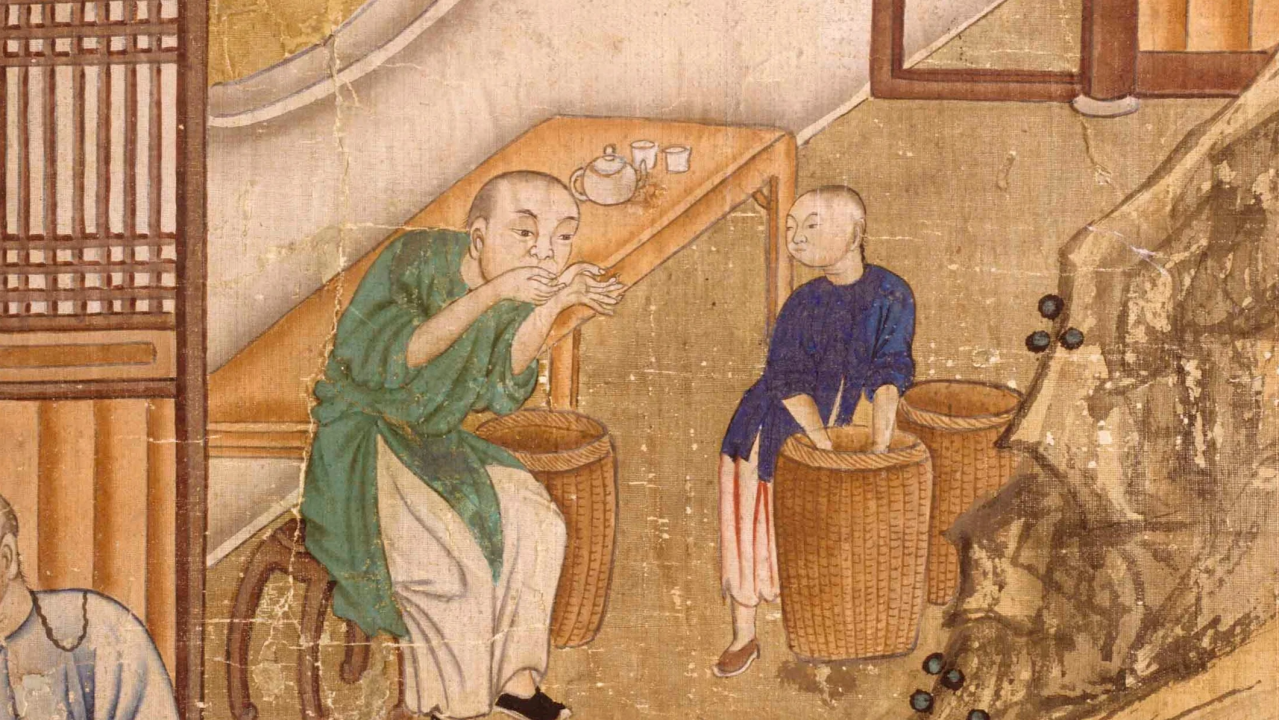
Painted wallpaper was not a Chinese domestic tradition. Interior walls there were generally left plain — white, crimson or gold. What did exist, in the trading ports of Canton and Macao, was the practice of pasting paper over window openings and painting decoration onto it. The likeliest explanation is that European merchants saw this, admired it, and asked for something similar at room scale.
So an entire industry grew up in Canton producing, to an extremely high standard, a product made solely for export.
The most desirable wall in Europe was made by people who had no use for it.
Numbered, and made to the room
Here is the detail that ought to interest anyone who specifies walls today.
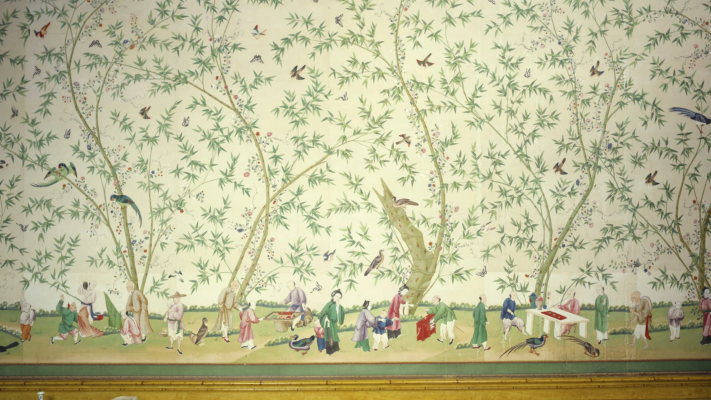
These papers were supplied in sets of twenty-five or forty pieces. Every sheet carried a different scene. They were sized to the dimensions of European rooms and hung in numbered sequence, pasted together to form one continuous decoration running the whole way around.
Not a pattern. Not a repeat. A single composition, divided into numbered panels, assembled on site in the correct order.
Which is precisely what happened in the lobby of W Melbourne in 2019, when 231 unique panels were printed, numbered and assembled like a jigsaw into two murals. The technology changed completely. The method didn’t change at all.

The imitation, and what it became
Demand of that kind always produces an answer, and the answer was industrial.
From the 1760s, British manufacturers began producing single-sheet papers with Western interpretations of Chinese motifs — printed, hand-coloured, and explicitly intended as a cheaper alternative to the hand-painted imports. Chinoiserie, in other words, began as a workaround for the fact that the real thing cost too much.
That impulse ran on through the block-printing workshops of France, where Zuber and Dufour turned the room-sized picture into something a machine and a hundred thousand woodblocks could reproduce. It runs through roller printing, and through the digital press. Every printing method we now take for granted exists because a hand-painted wall was too expensive to be general.
The line that never broke
What tends to get lost in that story is that the original method never stopped.
Silk painting is among the oldest decorative techniques in continuous practice anywhere, and it survived the entire industrial detour. In Milan, Misha combines Eastern painting technique with European perspective — chinoiserie, Japanese influence, the Grand Tour — painted and embroidered by hand onto silk, with silk thread worked into the surface to give real relief. Two traditions, resolved on one wall, in the way the Canton painters were reaching for three hundred years ago.
The difference is that this time nothing is lost in translation. Misha is Milanese, and its name is half Shanghai.
At Woburn, the silver pheasant is still there. Somebody painted it in a workshop in Canton in about 1750, for a room they would never see, in a country they would never visit, in a house whose owner they would never meet.
It outlasted everything hung on top of it.
Sources: V&A, Chinese wallpapers and the chinoiserie style · Brighton & Hove Museums, The Global Appeal of Historic Chinese Wallpaper · The Irish Aesthete, Chinese Walls · The History Blog, on the Woburn discovery