
Design history · The pictured wall
The room with no windows.
Two hundred years before digital print, a French workshop was solving the same problem — how do you put a picture on a wall and make it mean something?
The Diplomatic Reception Room in the White House began life as a boiler room. Oval, windowless, and by the late 1950s thoroughly forgettable.
In 1961, Jacqueline Kennedy hung a horizon in it.
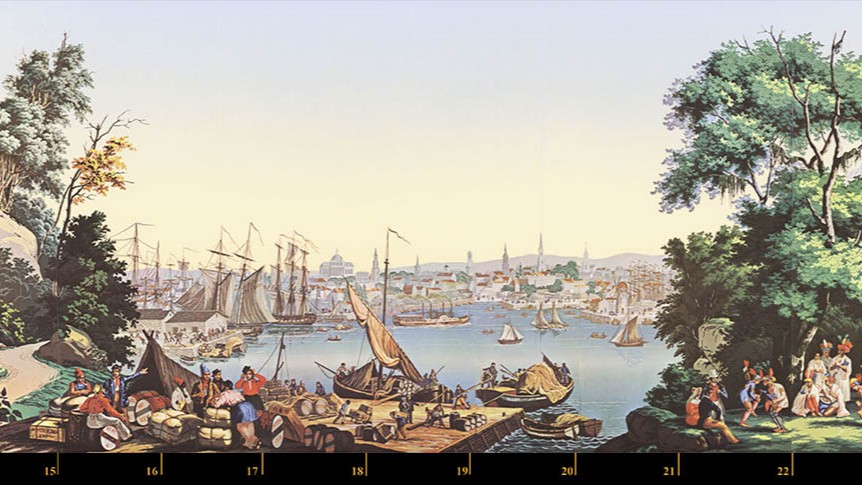
On the advice of the collector Henry Francis du Pont, she acquired an antique set of Les Vues d’Amérique du Nord — a French panoramic wallpaper depicting Boston Harbour, West Point, Niagara Falls, the Natural Bridge in Virginia, New York Harbour. It had been rescued from a Maryland house days before demolition. Installed around the curved walls, the sweeping landscape gave a windowless room something to look out at.
Not decoration. A solution to an architectural problem, using a picture.
The press reported that the First Lady had spent twelve thousand dollars on French wallpaper, and some of the coverage was not kind. It missed the point rather badly.
The workshop at Rixheim
The paper came from Zuber et Cie, founded in 1797 at Rixheim in Alsace by Jean Zuber, and still trading today — the oldest wallpaper manufacturer in the world, and the only one that never abandoned woodblock printing for panoramic work.
Zuber was not alone at the start. Joseph Dufour founded his workshop in Lyon the same year, and produced panoramas of Captain Cook’s South Seas voyages within a decade. This was the era of the Grand Tour and of naval expedition, when the public imagination was fixed on places most people would never see. The panoramic wallpaper answered that appetite exactly: a room you could stand inside and be somewhere else.
What separates these papers from everything that came after is a single decision. They do not repeat. A conventional wallpaper is a tile — one design, multiplied until the wall is covered. A panoramic scene runs continuously around every wall of a room, and no section is the same as any other.
That decision is why they were extraordinary, and why they were almost unaffordable.
1,690
woodblocks for one panorama
223
colours, each needing its own block
20
engravers, working a full year
Every colour in the design required its own hand-carved pearwood block, applied one at a time in exact sequence. Les Vues d’Amérique du Nord alone consumed 1,690 of them across 223 colours. A complete set could occupy twenty engravers for a year before a single sheet was printed.
Before any of that, the background. Four people working simultaneously, hand-brushing a graduated wash across the paper to build the sky — a process measured in weeks, not hours, and still done the same way today.
Zuber’s archive holds well over a hundred thousand of these blocks, cut between 1797 and 1830. The company still prints from them. Individual antique panels change hands for the price of a small car.
The pictured wall was never a new idea. It was an expensive one.
What actually changed
Between 1804 and 1860, Zuber produced somewhere north of twenty-five panoramas. Twenty-five, in fifty-six years — because at 1,690 blocks apiece, that was the pace the technology allowed. Each one was a capital project.
So the pictured wall stayed where the money was. Palaces, embassies, the houses of people who could commission a landscape the way they might commission a portrait.
The ambition never went away. Designers have wanted image at room scale for two centuries. What stood in the way was never imagination; it was the cost of carving wood.
Digital printing removed that obstacle, and the numbers are worth sitting with. A non-repeating, room-scale, made-to-order image now starts at one square metre. Not five hundred. One.
The same ambition Zuber spent a year of twenty engravers’ labour to achieve is now available on a fire-rated commercial wall, at the scale of a single sample board.
The part that hasn’t changed
It would be easy to read that as a story about technology getting cheaper. It isn’t, quite.
What made the Zuber panoramas endure — what still makes people rescue them from houses facing demolition — is that each one was doing a job. Giving a landlocked drawing room a coastline. Giving a windowless oval room a horizon.
We saw the same thing recently on two very different projects. In the lobby of W Melbourne, artist Rus Kitchin’s canopy of Australian flora and fauna rises over a recreation of Hosier Lane, so a guest walking in knows immediately which city they are standing in. At Epworth Richmond, a gum leaf pattern runs through the surgical theatres — not for the visitors, but so microsurgeons working at close focus have something distant to rest their eyes on before returning to the millimetre.
Neither is decoration. Both are a picture solving a problem, which is precisely what was hanging on the wall of that oval room in 1961.
The technology got cheaper. The brief didn’t get easier.
Got a project that doesn’t fit the folder?
Sources & further reading: SFO Museum, Zuber: The Art of French Scenic Wallpaper · Princeton University Graphic Arts Collection · France Today, Zuber: Wallpaper as Art · Maison Pierre Frey