
Material history · Trevira CS
The mistake in the name.
A trademark registered on a misremembered Latin place name in 1932. Everything that happened afterwards was deliberate — including eight years spent solving a problem nobody had asked for.
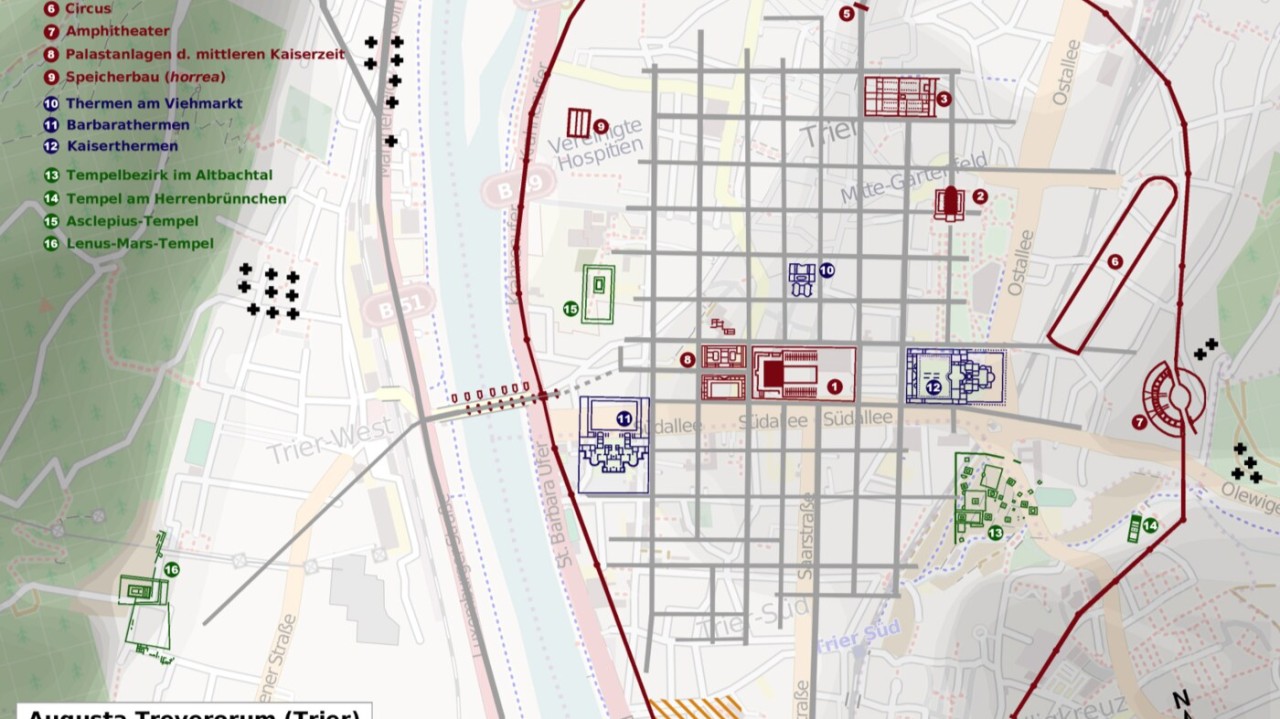
Augusta Treverorum: the city Kämpf thought he was naming. Map by M. Müller via Wikimedia Commons, licensed CC BY-SA 2.0; resized and saved as JPEG.
In 1932 Adolf Kämpf, plant director of an artificial silk factory at Bobingen near Augsburg, registered a trademark. He called it Trevira, believing the name derived from his town’s Roman name, Augusta Treverorum.
It doesn’t. Augusta Treverorum is Trier, four hundred kilometres away on the Moselle. Augsburg is Augusta Vindelicorum.
The name stuck anyway. Ninety-four years later it sits behind more commercial curtain and upholstery fabric than any other flame-retardant fibre in the world, and almost nobody who specifies it knows where the word came from — or that it came from the wrong city.
That is the last accident in this story.
The unglamorous decision
Hoechst acquired the Bobingen works in 1952 and launched Trevira as a polyester brand in 1956, at five thousand tonnes a year. Twenty years on, in 1972, a group of Hoechst researchers sat down with a group of their customers to attempt something the industry had not managed: a fibre that was permanently flame retardant.
Not a fabric treated to be flame retardant. The distinction mattered then for the same reason it matters now. Treated cloth is cloth plus chemistry, and chemistry applied to a surface comes off a surface.
They tried modacrylic and set it aside — making it work meant loading it with PVC. They tried several polyester modifications. And the reason they settled on polyester is the least romantic sentence in the entire history of the fibre: it could be laundered.
That was the whole calculation. A contract textile goes into a hotel, a hospital, a theatre, an office. It gets taken down and washed, over and over, for decades. A fibre that could not survive that was no use, however well it resisted flame. So they chose the polymer with the best care characteristics and set about changing it from the inside.
By 1975 they had it — an organophosphorus compound bonded into the polyester chain as a co-monomer, making flame retardancy a property of the molecule rather than a coating on the cloth. First samples went out in 1977. Market launch came in 1980.
The letters they added to the name were CS. Comfort and Safety — in that order, from the first day. The patent took the German Industry Innovation Prize in 1982.

Safety was the easy half
A fibre that will not carry a fire is a solved engineering problem. A fibre a designer actually wants is not.
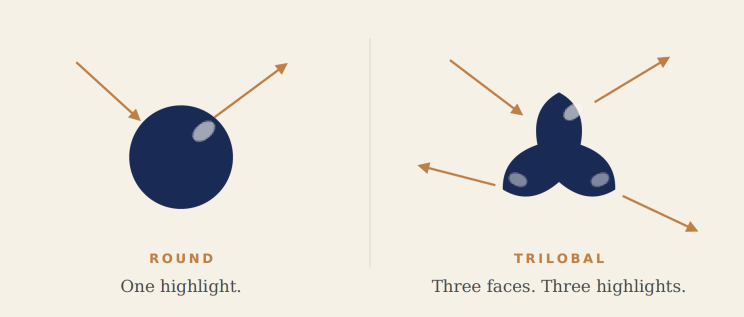
Early flame-retardant cloth looked like what it was. The fix was not a change of heart about aesthetics; it was arithmetic. Every additional yarn type in the programme is another decision a weaver can make, and through the 1980s and 1990s Trevira kept adding them. By 1995 the range had passed two hundred fibre and yarn types. Flat yarns from 33 dtex — finer than a human hair — through textured yarns up to 4,000. Round filaments and trilobal ones.
That last detail is the quiet one. Silk owes its lustre to a triangular cross-section with rounded edges: three faces scatter light in a way a cylinder cannot. Spin a polyester filament trilobal and it throws light the same way. The sheen is geometry, not finish — which is why a flame-retardant polyester can read as silk without pretending to be it.
In 1998 came Pemotex, a textured filament carrying a low-melting component, so a fabric could be stiffened with heat instead of chemistry. Monofilaments finer than a hair followed in the 2000s. Bioactive, antimicrobial as well as flame retardant, arrived in 2004.
The designers came too. Through the 1990s, Putman in Paris, Mendini in Milan, Clodagh and Gary Grain in New York all worked in the fibre. Design awards followed — GranDesign in Milan and Stuttgart, the Baden-Württemberg International Design Award, an iF Award from Hannover.
A cake ten metres across and eight metres high, carrying twenty designer chairs.
In 2000, twenty years after launch, Trevira marked the anniversary at Decosit in Brussels with exactly that: a birthday cake at architectural scale, bearing twenty pieces of furniture made by twenty designers, every one of them upholstered in the fibre. By that point an estimated eight hundred million square metres of Trevira CS fabric had been sold since 1980.
The years nobody puts in the brochure
What came next is worth recording, because the tidy version leaves it out. Contract furnishing fell roughly twenty per cent after September 2001. The market recovered through 2003 and 2004, then the financial crisis arrived and cost pressure with it, and Turkish production became a serious competitor. Hoechst had begun dismantling itself in 1994 and completed its exit from the fibre in 2000. Trevira passed through other hands and now sits with Indorama Ventures.
Through all of it the molecule did not change. It is the same modification settled on in 1975 — which is a strange kind of achievement in a chemical industry that reformulates constantly.
The problem the solution created
There is an irony buried in the chemistry, and it took forty years to surface.
The co-monomer is what makes the flame retardancy permanent. It is bonded into the polymer, so nothing can wash it out, wear it off or age it away. That is the entire proposition. It is also what made the material extremely difficult to recycle: a polyester with a phosphorus compound built into the chain does not behave like ordinary PET in a recycling stream.
The fibre that could not lose its flame retardancy could not easily be turned back into fibre, either.
Work on that has come quickly. Recycled Trevira CS, at fifty per cent post-consumer bottle content, arrived in 2020. A take-back programme with the recycler ALTEX in Gronau followed in 2023, turning used textile into insulation and acoustic material. In 2022 the flame-retardant polymers earned GreenScreen certification, the benchmark used by the Healthier Hospitals initiative.
Then, in January 2026, the piece that had been missing. Following a partnership announced the previous November with Jiaren Chemical Recycling, Trevira CS Eco fabrics can now be made from flame-retardant fibres and yarns containing fifty per cent textile-recycled content. Not bottles — textile. Old cloth becoming new cloth, with the flame retardancy intact on the other side.
Forty-six years after launch, the awkward consequence of the original idea has an answer. The co-monomer that made the fibre permanent no longer makes it disposable.
Why any of this matters at a sample board
Because the fibre is invisible, and invisible things get taken for granted.
A designer in Melbourne or Auckland meets Svensson, or Gabriel, or one of a hundred other mills. They do not meet Trevira. The name is not on the label, not on the sample card, not in the specification. What travels into the project is a decision made in a German laboratory in 1975 by people choosing a polymer because it would survive a commercial laundry.
Every year those mills enter their best cloth into a Trevira competition judged across five categories, and the winners read like a natural-fibre catalogue: wild silk, finest chenille, linen damask, wool bouclé, a crushed paper texture, a gauze like coloured glass. All of it flame retardant. Trevira’s own summary is the fairest description anyone has managed — in appearance it is frequently impossible to distinguish them from textiles made from natural fibres.
The name came from the wrong city. Everything after that was on purpose.
Specifying curtains that have to perform?
Sources & further reading
Trevira GmbH, Company History — on the 1932 trademark, the Bobingen works, Hoechst, and the 1956 brand launch.
Textination, Trevira CS — A pioneer celebrates 45 years — on the 1972 development programme, the choice of polyester, the 1975 modification, the designer collaborations, the Decosit anniversary, and the post-2001 market.
Trevira, Fabric for Ideas: Comfort & Safety, Design & Function — on the yarn programme and the comparison with natural fibres.
Trevira filament yarn specifications — on dtex ranges and round and trilobal cross-sections.
Trevira CS Fabric Competition 2025 results — on the winning fabrics and categories.
Textile World, January 2026 — on Trevira CS Eco and the Jiaren Chemical Recycling partnership.